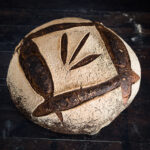
Description
A true Tourte de Meule is a sensory experience, defined by the rustic character that comes from its traditional ingredients and long fermentation.
Crust
The crust is arguably one of its most defining features. It is typically:
- Thick and Hearty: Baked at a high initial temperature, the bread develops a substantial, deeply caramelized crust.
- Deeply Browned: The color ranges from a dark golden brown to a deep, rustic brown, which contributes significantly to the overall flavor.
- Chewy and Crisp: When fresh, the crust has a satisfying crispness that gives way to a pleasant chewiness. It’s not delicate or flaky, but robust and substantial. The crackling sound it makes when cooling is a classic sign of a good bake.
Crumb
The inside of the loaf offers a beautiful contrast to the rugged exterior:
- Soft and Moist: Despite the thick crust, the crumb is known for being wonderfully soft, moist, and tender. This is often achieved by a high hydration level in the dough.
- Open and Irregular: A well-made Tourte de Meule will have a moderately open crumb with irregular hole sizes—a hallmark of wild yeast fermentation. It’s not overly airy like a ciabatta, but it shouldn’t be dense.
- Creamy, Amber Color: Because it’s made with stone-ground T80 flour, which contains more of the wheat bran and germ, the crumb has a beautiful, creamy off-white or light amber color, flecked with darker bits of bran.
Taste
The flavor is where the Tourte de Meule truly shines. It is complex and layered:
- Earthy and Nutty: The primary flavor comes from the stone-ground flour, lending it a rich, earthy, and distinctly nutty or wheaty taste that is much more pronounced than in breads made with standard white flour.
- Slight Sourdough Tang: As a naturally leavened bread, it has a pleasant, mild sourness from the sourdough starter. This tang is not overpowering but beautifully balances the richness of the flour, adding complexity.
- Caramelized and Roasted Notes: The dark, thick crust imparts deep, roasted, and caramelized flavors that permeate the entire loaf, making every bite a rich and satisfying experience.
In summary, the Tourte de Meule is a bread of wonderful contrasts: a rugged, flavorful crust protecting a soft, moist, and tender crumb, all delivering a complex taste that is both rustic and deeply satisfying.
Ingredients
Scale
- 660 g T110 flour (alternative: German Type 1050 wheat flour)
- 500 g water (cold)
- 300 g wheat sourdough starter (levain)
- 17 g salt
- 30 g water (for bassinage)
Instructions
- Mix all ingredients except for the salt and the bassinage water, then cover and let rest at room temperature for 1 hour.
- Knead the dough at medium speed until it begins to develop elasticity. Now add the salt and continue kneading until the gluten structure is fully developed. If you are using a high-quality flour, you can now knead in up to 30g of additional water. Cover the dough and let it rise at room temperature for 3 hours. Perform a set of stretch and folds after the first hour and again after the second hour.
- Turn the dough out onto an un-floured work surface and shape it into a tight ball. Place it seam-side up into a floured proofing basket (banneton). Cover with a cloth and let it proof in the refrigerator for 12 hours
- Carefully turn the dough out onto a piece of parchment paper. Lightly dust the surface with flour and then score a diamond pattern with 4 vertical cuts. In a preheated oven at 250°C (top/bottom heat), pre-bake with plenty of steam for 10 minutes. Reduce the temperature to 220°C and bake for approximately 55-60 minutes until the crust is a deep, dark brown.